

A New Era of Connected Care
Every Dreamforce brings bold ideas, but few hit home for healthcare leaders like this year’s Healthcare Keynote. Salesforce didn’t just showcase new technology — they reframed how the industry can balance digital efficiency with human connection.
As someone who’s spent years helping provider and payer organizations modernize with Salesforce, I’ve seen firsthand the pressure our industry faces: clinician burnout, manual workflows, disconnected data, and patients who often fall through the cracks. This keynote was a call to action, and a glimpse at how AI agents could finally help us close those gaps.
Key Takeaways
-
- The future of healthcare isn’t just digital; it blends AI-driven automation with human empathy.
- Data activation, not data collection, will determine which providers deliver better outcomes at lower cost.
- Agentforce 360 for Health bridges long-standing gaps in interoperability, patient access, and payer-provider collaboration.
- Early adopters are demonstrating that AI can reduce administrative burdens and deepen patient connections.
From Automation to “Agentic” Healthcare
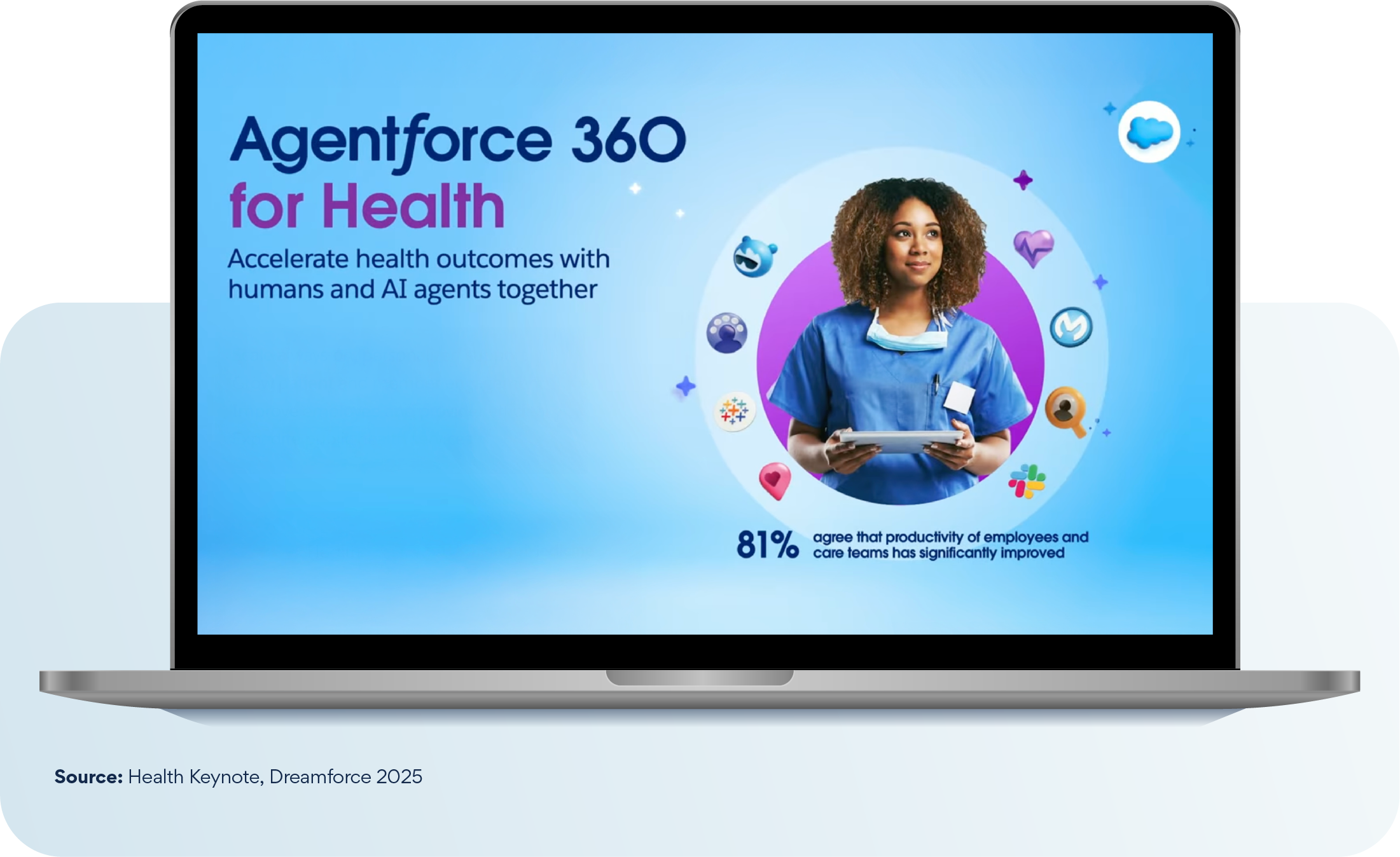
Salesforce’s Agentforce 360 for Health represents a major leap forward not just in efficiency, but in how healthcare is delivered.
This isn’t about replacing people with AI; it’s about amplifying clinical and administrative teams through intelligent, context-aware assistants that work within the flow of care.
Imagine a world where:
-
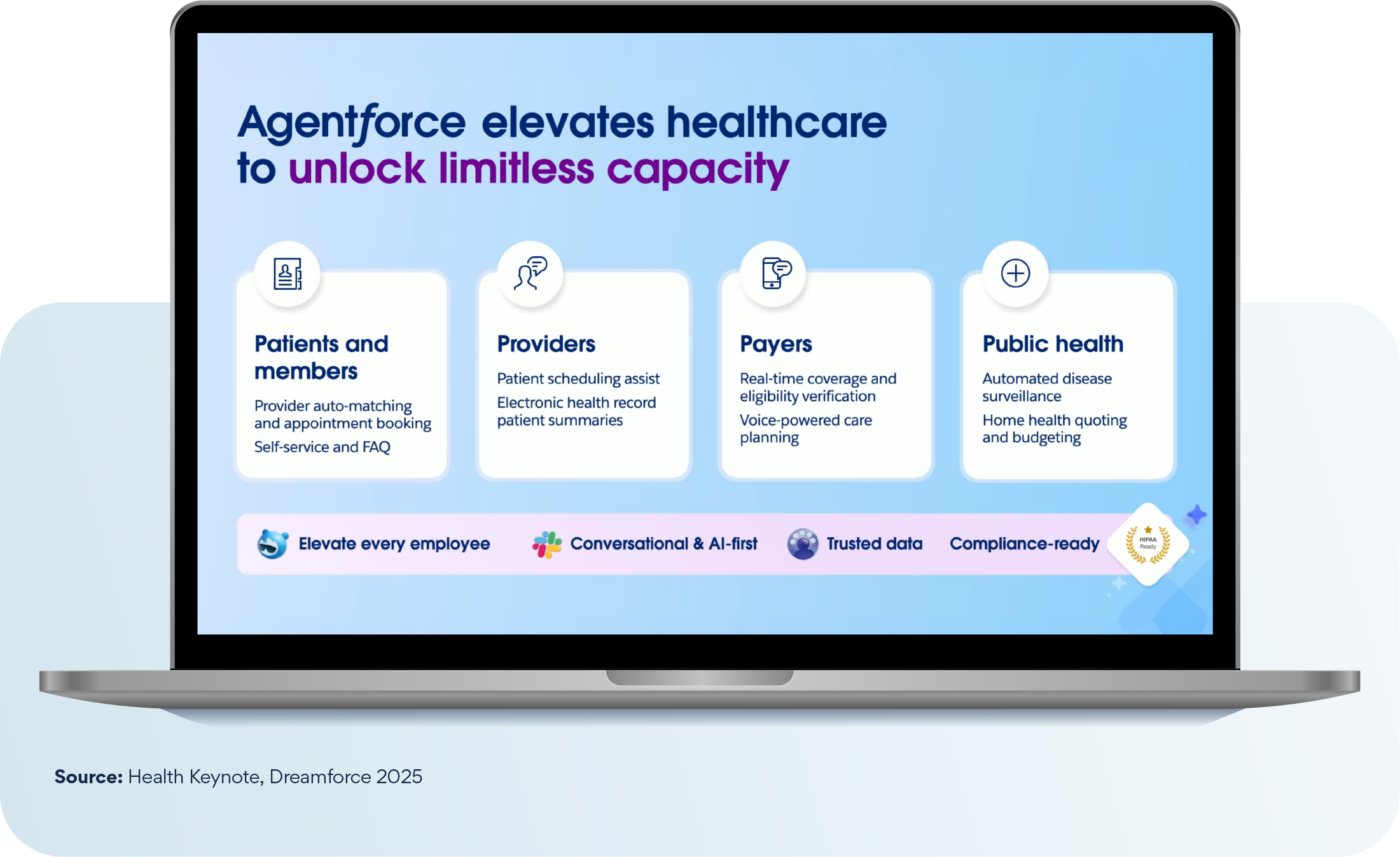
- Patients schedule appointments automatically based on eligibility and availability.
- Providers summarize visits in seconds using voice-activated reports.
- Payers verify prior authorizations in real time — no faxes, no delays.
- Public health departments detect outbreaks before they spread.
Why Interoperability Is Still the Real Game-Changer
One of the keynote’s most powerful moments came from Salesforce’s Healthcare GM, who addressed a hard truth: healthcare generates 30% of the world’s data, yet most of it remains unusable. The reason? Legacy systems, siloed EHRs, and inconsistent standards are prevalent issues.
Salesforce’s answer is a unified data foundation built on Health Cloud + Data 360 + MuleSoft Health APIs, allowing systems to communicate seamlessly without moving data. This “zero copy” approach keeps PHI secure while making it accessible in real time.
In short, Salesforce is shifting the conversation from data storage to data activation, ensuring information is helpful in the moment decisions are made.
Where Healthcare Leaders Go from Here
If Dreamforce made anything clear, it’s that AI in healthcare is no longer optional; it’s foundational. But adopting it well requires three key actions:
-
- Start with strategy, not software. Identify your high-volume, high-friction workflows first.
- Focus on interoperability. AI is only as good as the data it can access — securely, and in context.
- Empower your teams. Digital labor should reduce burnout, not add new complexity.

Torrent’s Take
At Torrent Consulting, we see Agentforce for Healthcare as a pivotal step toward a connected, intelligent health ecosystem, but also one that requires strategic alignment before technology deployment.
The shift from systems of record to systems of action means success will depend on data readiness, process design, and change enablement as much as platform capability.
Our teams are already helping provider and payer organizations navigate that evolution, activating data, integrating AI agents, and building workflows that enhance care delivery, not disrupt it.
The healthcare organizations that act now won’t just adapt to the new model, they’ll lead it. If you’re ready to shape the next chapter of patient-centric innovation, connect with Torrent Consulting to design your AI-ready roadmap.

